Showing posts with label Ternate. Show all posts

Thursday, February 27, 2014

Gen. Gregorio Lim Marine Base: "Borácay de Cavite"


The Philippine Marine Corps named this place Marine Barracks Gregorio Lim. Ternateños refer to it simply as "marine base". But we'd rather call it —and the whole of Ternate for that matter— as "The Other Side of Cavite". The municipality, most especially the territories outside the town proper, is really something else that is almost "un-Cavite" for those who have been accustomed to the urban side of the province (the most familiar image to many, I suppose). Whenever Cavite is mentioned, almost immediately the stark stolidity and coldness of concrete and infrastructure come to mind: there's the robotlike queue of vehicles at the toll gate of CAVITEX, moving as if they're in a conveyor belt; the mushrooming subdivisions and commercial centers of Bacoor, Dasmariñas, and Imus; the unswimmable waters of Ciudad de Cavite, Noveleta, and other coastline municipalities; the lonely humming of machines in the Cavite Economic Zone and other industrialized areas; the monstrous traffic jams at Aguinaldo Highway with its gigantic, unfriendly looking concrete electrical posts; Bong Revilla, etc. I could go on and on, but I think you get the sad picture already.

The blunt reality is this: much of Cavite seems to be a lonely place for tourism to thrive on. Well, there's Tagaytay, of course, but it's on a league of its own (at the back of many tourists' minds, they don't even place the city by the ridge vis-à-vis the general imagery of mainstream Cavite). However, when one thrusts further southward, way beyond the humdrum or urbanized Cavite, one encounters an undiscovered freshness of air that seems to have been surreptitiously kept away from the "curse of modernization". To this, Ternate says "hello!" — or rather, "¡Hola!" For Ternate (sans the modern architecture of homes) seems to have been suspended in time. Its mores, its values, its faith, its language, they are all there, still intact, still strong, simply waiting for curious urbanites to take notice and give them their overdue acknowledgement.

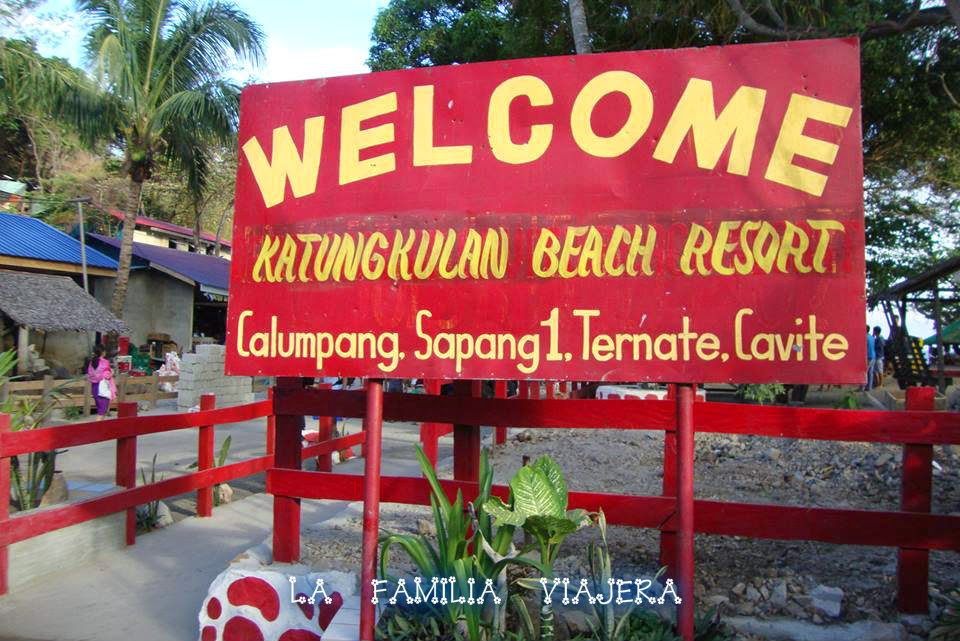
Puerto Azul and Caylabne Bay Resort may well be Ternate's gems in the field of tourism. But they cater mostly to the gilt-edged. Not all beach goers are from the gentility. So this is where Katungkulan* Beach Resort comes in.

The entrance to the marine base which also leads to its white-sand beach resort. With its intimidating reputation as a military barracks, who would have known that it has a beach resort that is open to the general public? Not us, and not to many.

Coming from the entrance, the well-paved road continues to fork upwards through thick vegetation (with lots of monkeys!). Nearing the beach proper, one will be rewarded with a view of the beautiful cove far below.

Among the locals, this place is more popularly known by its former name: Borácay de Cavite.

Just arrived!

Juanito could not contain his joy!

Krystal still feeling cold. We arrived here before 7 AM, and the cold northeast winds made the waters too choppy one might think there was an ice plant nearby.

♥ Warmth in the midst of cold breeze. ♥


Katungkulan Beach Resort faces the entrance, or the mouth, of Manila Bay. The islands of Corregidor and Fort Drum are in full view. And on a sunny day, the mountains of Bataán could be seen. This beach was formerly known as Borácay de Cavite because its whitish sands resemble those of that world-famous island resort in Malay, Aclán. Not as white, though, but fine enough for you to walk on a sunny day even without sandals; the sands won't hurt your soles, promise!


We used one of those cottages for free. Nobody was there to charge us, anyway. Maybe it's really for free.


Jefe, Juanito, and Momay having the time of their young lives. The waters in the beach front is very shallow, safe for kids to swim.


Little Juanito braving the gentle waves!

That's no ship in the distance. That's Fort Drum, a heavily fortified island fortress formerly known as El Fraile. A mere islet a long time ago, it was transformed into a steel-reinforced concrete fort by U.S. Army engineers and was named after Brigadier General Richard Drum. The island fortress resembles a massive concrete ship. Its purpose was to defend the entrance to Manila Bay. Fort Drum is already out of commission as it was heavily damaged during World War II. We hope to visit the island one day.

Eastern point of the cove.

Western point of the cove.

Whitish sands.

Since Katungkulan Beach Resort is virtually inside Marine Barracks GregorioLim, this could probably be the most secure beach in the country! Entrance is also dirt cheap: just ₱100 per person. And if I may add, it's also one of the cleanest we've seen because we saw low-ranking marines (privates I think they are called) periodically cleaning the beach front. It is recommended that you bring your own food. There is a carinderia there and you can order from them almost any Filipino meal you want; just give them money and order the food about an hour or two in advance, and they'll do the rest (at least, that is what they did for us). The only catch is that they charge a bit too much. So might as well pack some marinated barbecue and other similar grub for you to cook on your own (yep, grilling is allowed so long as you don't get to grill your own arms).

All in all, our day-tour beach experience in Ternate is a satisfying one! Highly recommended for the budget-conscious beach lover! The "military serenity" of Katungkulan Beach Resort —the "Borácay" of Cavite— will give you a new perspective on how you view this historical province.

Remember: summer's around the corner!


♥L♥A♥F♥A♥M♥I♥L♥I♥A♥V♥I♥A♥J♥E♥R♥A

*Katungkulan (original spelling: catunculan) means "duty" in English. The name of the resort emphasizes and inculcates the meaning of the word into the minds of the Philippine Marine Corps, that it has a sworn duty to defend and protect the republic and everything else it stands for. So yes, you'll be safe here. Because the marines are not cops. =)

Tuesday, February 25, 2014

Ternate: the other side of Cavite

Si no sabe mira donde a vine
No di yega donde quiere inda.
—Ternateño Chabacano Proverb—

And that's why we're back, and this time with the whole Alas caboodle!

The last time we were in Ternate was almost three years ago. But there were only three of us: me, Yeyette, and Krystal. Our main purpose during our first trip to Ternate was to document the town: its parish church, ancestral houses (we saw only one and it didn't even look that ancient), and its Chabacano-speaking populace (there were quite a lot of them!). But last February 16, all of us including our three boys journeyed to Ternate, this time for a beach escapade! It's because Yeyette's cough did not dissipate when we went to Manila Bay a week before. She was hoping that a gulp of fresh sea breeze would clear her lungs. But there was no breeze at all because of the unwanted easterlies. That's why she thought of visiting the sea once more. This time around, we really had to be in a beach somewhere near our home. We checked the map and decided to go to Puerto Azul. Yeyette had really wanted a cool gust of sea air (it has this "placebo effect" on her somehow), so me and the kids had no other choice but to comply. Not that we were complaining, hehehe! Life's a beach, lest you forget! Especially for kids! And to paraphrase Pinay Travel Junkie, it's summer when we say so. =)

We left San Pedro Tunasán very early, before 4 AM, because Yeyette was really after the early morning breeze from the sea. We were supposed to take a much shorter route, via General Mariano Álvarez and Dasmariñas (Caviteño towns that are just beside La Laguna). Unfortunately, there were still no jeepneys plying that route on that hour. So we had to drag our still sleepy selves all the way to Parañaque's Southwest Integrated Provincial Transport Terminal (in Uniwide Coastal Mall) for a bus ride going straight to Ternate.

Welcoming ourselves back to Ternate! The Chabacano message on the arch means "We welcome all of you wholeheartedly".

We arrived just a few minutes past six in the morning, dropping off at the junction of Calle Ventura (which leads to the town proper) and Governor's Drive beside a pasture . It was a freezing morning! The people were wearing sweaters and jackets when we got there. We asked around on how to get to Puerto Azul. We were dismayed to learn from the tricycle drivers stationed there that Puerto Azul's management does not allow them entry (why, Puerto Azul?). We just asked to be brought only to the entrance, and we'll take it from there. But they warned us that it's gonna be a long walk from the entrance to the beach proper. So they offered us another alternative: Marine Barracks Gregorio Lim, popularly known as Marine Base, in faraway Barrio Calumpang.

I'm familiar with the place, the Wikimapia aficionado that I am. Judging from the online satellite imagery, the white sands seemed enticing enough especially for beach lovers like Yeyette. However, I wasn't really sure if people are allowed to come in. But the tricycle drivers reassured us that they've been bringing tourists there all the time. When we finally agreed, they charged the six of us for 300, double that for a two-way trip. Yeyette was able to bargain for a 50-peso discount. Later on, we realized that the fare was fair: our destination was so far that for a brief moment during the trip, I wondered if we were still in Ternate.

Yeyette and the boys packed the trike's sidecar while me and Krystal were seated behind the driver. The trike ride sliced through a smooth paved road which zigzagged through steep and high ravines and swished through thick forests. We were rewarded with a breathtaking view of Cavite's rural sceneries as well as its last remaining forest cover (the long and winding road we trekked upon was actually at the foot of the Pálay-Pálay National Park where the famous Pico de Loro mountain is situated). The relaxing trip to the marine base was coupled with a chilly morning air that we've been craving for in Manila Bay. But it got too cold it already hurt our feet (me and Krystal were wearing only sandals). I guess we got more than what we've bargained for!

We love roads like this! This lovely  highway leads to the marine base and passes by the entrance to Puerto Azul. It ends at Caylabne Bay Resort (we heard that it's undergoing renovation). We have seen no other road like this even in our adopted home province of La Laguna because there are long stretches of it without any roadside houses nor stalls which are typical nowadays in many provincial roads.

At the entrance to the marine base. My boys are ready for battle... beach battle that is!

The fine white sands of Katungkulan Beach Resort, the formal name given by the marines to their Borácay-like sanctuary (if they consider it as such).

Juanito, Jefe, and Momay enjoying the shallow waters.

After swimming, we visited the newly opened Kaybiang Tunnel, a 300-meter underground tunnel which connects Ternate to Nasugbú, Batangas.

By the way, a brief backgrounder about Ternate and its linguistic heritage: just in case one says that the whole province of Cavite is purely a Tagalog-speaking region, he should rethink this. To the northeast of the province, there’s Ciudad de Cavite with its senior citizens speaking Cavitén (a Chabacano variant). And at the southwesternmost tip of Cavite province lies this quaint fishing town called Ternate. But this is no ordinary town; like Ciudad de Cavite up north, this place is frequented by linguists, polyglots, and Hispanists because of the townsfolk language: Chabacano. But the Chabacano spoken in Ternate is different from its Cavitén counterpart. According to Dr. Evangelino Nigoza, the town’s historian and foremost defender of the language, Ternateños call their native tongue “Bahra”. The linguistic structure of Bahra is “another world” of its own. And in my opinion, it is rather more difficult for a Spanish-speaker to understand because Bahra is somehow influenced by the Portuguese language aside from the fact that Ternateños tend to speak it so fast (they seem to tweedle when they do so).

But why Portuguese? It is because Ternateños are actually the descendants of Malays from Ternate Island in the Moluccas archipelago. These islands were formally possessions of Portugal. The first Ternateños were brought to the Philippines by the Spaniards in 1663. These Malay recruits were called Mardicas or “men of the sea”.

There were two reasons why the Mardicas chose to leave Ternate Island: the island was highly volcanic, and; to help defend Manila from Chinese pirate Koxinga. Fortunately for Governor-General Sabiniano Manrique de Lara (who ruled the Philippines during those panic-stricken times), Koxinga fell ill and died. But the Mardicas never returned to their native land due to the place’s severe volcanic activity. Instead, they were given a spot in Bagumbayan (now Rizal Park) in Ermita, Manila.

It is perhaps during their brief stay in Bagumbayan that their language was further developed, for the people surrounding their little barrio, the Ermiteños, spoke Chabacano Ermiteño, Spanish, and Tagalog. However, frequent squabbles with the Ermiteños forced the Spanish authorities to move the Mardicas people to another place. Bahra de Maragondón (now Maragondón) in Cavite was chosen for them since the place was frequently attacked by Moro pirates. Anyway, it was agreed earlier that they were to help fight Koxinga in Manila. But since that never materialized, it was decided that their military services should still be used, but somewhere else.

In Bahra de Maragondón, the Mardicas settled at the mouth of the Maragondón River. But it was a swampy area filled with mangrove trees. These were cleared through the years, prompting them to till the soil. So aside from fishing, the early Mardicas were also farmers. They also intermarried with the natives of neighboring villages. They also built a watchtower which they called Mira — maybe that’s how they call a watchtower because in Spanish, the word "mira" is the present indicative (third person) or present imperative (second person) of the verb mirar meaning “to watch”.

In due time, the spot where they cleared away mangrove trees became the foundation of present-day Ternate. Also, they renamed their new home: from Bahra de Maragondón to Ternate, in memory of their former home in the faraway archipelago of Moluccas.

During the Spanish times, Ternate was just a barrio of Maragondón. Many years later, it became a separate town. In 1904, however, during the American occupation, Ternate was attached to the town of Náic. It became a separate town again in 1914.

Iglesia del Santo Niño de Ternate. It no longer has its original features. Ask World War II why.

Peaceful coexistence. The parish church is just perpendicular to the Iglesia Filipina Independiente (IFI). But I hope that the IFI will soon come home to the Catholic fold because we are no longer at war against Spain. That's the only reason why they separated from the Catholic Church to begin with. So now, there is really no more valid reason why they should remain "independent"... I'm sorry, I almost forgot that this is a travel blog.

Small world! That guy with the cap immediately recognized us upon our arrival. Turns out that he's the same candle vendor in front of Lumbán Church whom we saw last month (find his photo here)! Yeyette asked if the lady beside her is his mom. The lady politely replied that she's the wife! I promptly left after taking this photo.


It is said that Ternate survived various turmoils in the history of Cavite: the Tagalog rebellion of the Katipuneros as well as the invasion of both Yankee and Jap. But it barely survived the American retaking of the Philippines, and that was during the closing days of World War II. Only seven homes survived.

Oddly enough, the original Mardicas families who transferred from Ternate Island, Moluccas, Indonesia to the Philippines were also numbered seven. These families are:

1.) De la Cruz
2.) De León
3.) Estéibar
4.) Nigoza
5.) Niñofranco
6.) Pereira
7.) Ramos

Their descendants still live today. And surprisingly, they all know the history of their ancestors! Glad to know that the people here are history conscious.

Momay and Jefe at the entrance to Barrio San José (right beside the public market) where most Chabacano speakers of Ternate reside. But we did not go here anymore because Yeyette was already tired.

We did not tour the town proper anymore like we did the first time we were there. We just killed time in front of the public market before going home, chatting with some Chabacano ladies (using Spanish) while feasting on halo-haló. This, my friends, is the other side of Cavite. Beautifully strange.

Click here for more photos of our Ternate adventure!


♥L♥A♥F♥A♥M♥I♥L♥I♥A♥V♥I♥A♥J♥E♥R♥A

Up next: Ternate's humble beach paradise called "Borácay de Cavite"!

Sunday, November 3, 2013

The Alas Family traveling through the years

El mundo es un libro y quienes no viajan leen sólo una página.
—San Agustín de Hipona—

Traveling is not something that we initially planned to do for the rest of our lives. It simply has been happening ever since our family was established in 1999 (parang corporación lang, ¡hehehe!). We've been moving to a lot of places ever since, even without our own accord. We do not claim nor boast to have traveled to a gazillion of tourist spots all over Filipinas. Heck, the farthest our family has traveled up north was in Súbic Bay, and down south was in Tayabas province (sorry, but I simply refuse to call it Quezon... long story). As a couple, me and Yeyette are the most traveled. We've been outside of Luzón three years ago when we toured the famed island of Borácay and the eastern coast of Aclán. Recently, I was able to go to Mindanáo, but on my lonesome. As a family, we have yet to tour a much larger Philippine space.


But this doesn't mean that we have had a limited travel experience. As the years went by, I noticed that we have had our family photos taken from various points of Luzón (thanks to my photo-addict wife). And I was delighted when I noticed that we have been taking our kids to unusual places, not the type of weekend families who are content of bringing their kids to malls, or to beaches only during summer. Looking back at these photos, both old and new, makes me and Yeyette feel so proud because we've been touring our kids not only to the usual places that parents bring their kids to. Of course we've been to malls and beaches. But how many parents today are even thrilled of bringing their kids to historical places, of introducing them to heritage structures, of having them enjoy natural spring waters and rivers and waterfalls, of making them climb grassy hills and play at little-known town plazas. Do parents today even bother to bring their kids to museums and enjoy old town fiestas? Would they mind if their kids get their hands soiled, or if they see them lying on the grass?

Humble as the following photos may seem, I still proudly present to you our family photos taken from various points in time and space (hover over the photos to view the dates when each of them was taken)...

The least-known but pristine waterfalls of Apiás in Abra de Ilog, Mindoro Occidental. Krystal was our only child back then. She was born on 20 July 2000, two days after my 21st birthday. Apiás is peculiar because it's just right beside the beach!

In a photo studio inside Festival Supermall in Barrio Alabang, Ciudad de Muntinlupà. Momay was born on the feast day of Our Lady of Fátima in 2004. Krystal and Momay were our only children when this photo was taken.

In the forest hills of Sitio Tagbong in Población, Abra de Ilog, Mindoro Occidental.

Krystal and Momay enjoying the icy waters of Río Matabang, more popularly known as Tagbóng, in Población, Abra de Ilog, Mindoro Occidental.

At Tagbong River in Población, Abra de Ilog, Mindoro Occidental.

At the open-air area of Greenbelt in Macati City. Because of its ultramodern look mixed with environment-friendly designs, Greenbelt has become one of the country's most awarded shopping malls and is a virtual urban oasis. Our caboodle grew to three with Jefe who is already a year old here. He was born on 13 January 2007.

At New World Renaissance in Macati City during a cousin's birthday.


At the Manila Ocean Park in Ermita (along the shores of Manila Bay) during Krystal's eighth birthday. The place was just four months old when we first visited it.

Dirt roads for us are romantic and thrilling! Our hearts go "bumpety-bump" whenever our ride passes by such roads. This photo was taken in some secluded sitio in the well-known barrio of Laíya in San Juan, Batangas on our way to the beach. So popular is Laíya's name due to its white-sand beaches that people tend to forget its only a barrio of San Juan!

Mommy mode in Laíya (Moonlight Beach Resort). That's little Juanito, just barely two months old (he arrived on 1 April 2009). So don't wonder why he's already used to traveling!

Inside the then second largest shopping mall in Filipinas: SM Mall of Asia. It is now the third largest mall (SM City North EDSA in Quezon City became the largest when it was modernized in 2008, followed by SM Megamall in Mandaluyong).

Enjoying the cool Christmas afternoon breeze of Bahía de Manila at the jampacked SM by the Bay right beside Seaside Boulevard and behind SM Mall of Asia.

Alabang Town CenterMuntinlupà City.

Momay, Yeyette, Krystal, and Jefe (behind his ate) at the controverial Alberto Mansion, the ancestral bahay na bató of José Rizal's mother in Biñán, La Laguna. This historic house, which once had Sir John Bowring as one of its distinguished guests, is now in shambles. Photo taken during Jefe's third birthday.

The smooth and scenic Southern Tagalog Arterial Road (informally referred to as STAR Tollway or CALABARZON Expressway) somewhere in Balagtás, Batangas. We were on our way to the Port of Batangas.

A relaxing bus ride. We're already used to this kind of traveling. Besides, it saves us the headache of having to contend with rising oil prices, not to mention road rage, haha! And I think it's much more comfortable having other people drive for us. Just saying.

At the Port of Batangas in Batangas City on our way to Puerto Galera. Little Juanito is the only one who's not looking at the camera, hahaha!

White Beach, Puerto Galera, Mindoro Oriental.

An idyllic sunset at Puerto Galera's White Beach.

That's me, parasailing over the waters of Puerto Galera.


Juanito, Krystal, and Momay enjoying a golden sunset at Filinvest Corporate City, Alabang, Muntinlupà City. Simple joys in life. =)

Foggy and cold up at the People's Park in the Sky in tourist-haven Tagaytay City, Cavite.

Krystal and Jefe along United Nations Avenue in Ermita, Manila. This street was formerly known as Calle Isaac Peral. Peral was a Spanish engineer who launched the Peral Submarine in 1888. It was the world's first electric battery powered submarine. They shouldn't have changed the name.

Krystal by the ancient wooden door of the San Agustín Church. This door has a carving of Santa Mónica (the mother of San Agustín) surrounded by rocaille ornaments. The lower half of this door was sawed away by Japanese soldiers during World War II to give way for their machine guns hidden behind sandbags. Although the door was reconstructed, one can still see the scar that was made by the Japs. Look closely.

At the entrance to the chapel of the now 111-year-old San Vicente Ferrer during his feast day in San Vicente, San Pedro, La Laguna, our home since 13 May 2004.

Swimming time at my mom's place at the Manila Executive Regency's penthouse pool in Ermita, Manila.

Manila Executive Regency, Ermita, Manila.

Manila Executive Regency, Ermita, Manila.

Yeyette and Krystal (with my sisters Jessica and Jennifer partly hidden among the crowd and palm fronds) during Easter Sunday 2011 inside Manila's famous Malate, Church.

Krystal, Jessica, Yeyette, and Jennifer at the door of Malate Church, officially known as the Iglesia de Nuestra Señora de los Remedios (Church of Our Lady of Remedies). So now you know why the street on the right side of the church is named as such. =)

Little Juanito in Playa de Malatandang, Tayabas Bay, Unisan, Tayabas (now Quezon) during a clan reunion.

Jefe and Yeyette at Camayan Beach Resort during a rainy summer two years ago. This beautiful resort is located in Mórong, Bataán at the Súbic Bay Freeport Zone, the former site of the much despised U.S. Naval Base Súbic Bay. Unbeknownst to many, the now tax- and duty-free zone encompasses three municipalities and one city, namely: Súbic and Olóngapo City in Zambales province, and; Hermosa and Mórong in Bataán province.

My daugher Krystal with —GASP!— Freemasons during the 150th birth anniversary of Rizal in his replica ancestral house in Calambâ, La Laguna. You know, throughout our country's history, these Freemasons have been conspi... ooops! I almost forgot: this is a family-oriented blog. I'm supposed to sound tame here, hahaha! :D

Pretty Praetorian Guards: Yeyette and Krystal on either side of the welcome arch which leads visitors to the Chabacano-speaking town of Ternate in Cavite province. The Chabacano inscription on the arch says "We welcome all of you wholeheartedly".

Travesía de Isla Verde, commonly known as Isla Verde Passage, divides Batangas and the island of Mindoro. Behind us is the Batangueño island of Maricabán where the municipality of Tingloy is located. A question: if the Spanish name Travesía de Isla Verde has already been translated to English, then why is it still called "Isla Verde Passage" instead of "Green Island Passage"? Filipinos: THINK. =)

Juanito and Yeyette enjoy a relaxing moment at the Casino Español de Manila, Ermita, Manila. The casino, founded on 31 October 1844, was a social club meant only for Manila's Spanish community. However, this historic place was constructed only in 1913 (during the U.S. occupation) and was inaugurated four years later. The edifice was destroyed during the Battle of Manila. It was reconstructed in 1951.

My family with our friends Valerie Isabel Devulder and Javier Wrana at the Casino Español de Manila. Fil-French beauty Valerie is the daugher of former commercial model Maridel Coching and the granddaughter of Francisco Coching, the "Dean of Philippine Comics". She is also a painter and one of Señor Guillermo Gómez's flamenco dancers. Javier is the president of the Asociación Cultural Galeón de Manila.

Madrigal Business Park, Alabang, Muntinlupà City. Nápadaan lang, ¡hehe!

ASEAN Garden at the CCP Complex in Pásay City just beside Roxas Boulevard (and near the border of Manila).

Harbor Square at the CCP Complex. Behind us is the wharf of the Manila Yacht Club.

My best rendition of a soccer player with Jefe and Momay at historic Freedom Park in UP Los Baños. The famous Fertility Tree and the Carillón tower at the background. Seems like a happy place, no? But on 23 February 1945, this site was a battlefield where nearly a hundred soldiers were killed. Historians now refer to that battle as the "Raid at Los Baños" wherein Allied forces (both U.S. Army Airborne and Filipino guerrilleros) attacked the Imperial Japanese Army to rescue POWs there. The rescue mission was a great success and is even regarded as one of the most successful rescue operations in modern military history.

Jefe checking out his invisible binoculars at Exotik Restaurant's beautifully landscaped garden in Loñgos (Kalayaan), La Laguna. If you are not gustatorily adventurous, then don't even dare ask what's on this restaurant's menu, LOL!

Getting ready for an exhilirating river tubing at the Panguil River Eco Park within the Sierra Madre rainforest of Páñguil, La Laguna. Krystal, Yeyette, Juanito, and Jefe are all set while Momay waits for his turn to be carried in front of the water ride.

Inside the moist forest air of the Panguil River Eco Park.

At the picturesque Manila East Road, Páñguil, La Laguna, where the air is healthy. Behind Yeyette is the way to Sinilóan town.


A vast rice field between us and Laguna de Bay behind. Still at Páñguil, La Laguna.

Yeyette (with Krystal far behind her) in front of the breathtaking façade of the 329-year-old baroque beauty San Pedro de Alcántara Church in Páquil, La Laguna.

Momay and Krystal watches young sculptor Franco Cagáyat looking for new images to sculpt. Franco is the son of the owners of this shop, JAC jr. WOODCARVERS located in Paeté, the Woodcarving Capital of Filipinas. This kid is famous for sculpting car models out of wood despite suffering from Asperger's syndrome (a mild form of autism). Among his clients are Honda and Mitsubishi.

Boat riding/water taxi ride at Nuvali's four-hectare multifunctional man-made lake (Santa Rosa, La Laguna). This was during Juanito's third birthday.

Jefe, Yeyette, and Juanito with Eldar in front of Santa Rosa, La Laguna's Enchanted Kingdom, the country's answer to Disneyland.

Jefe, Momay, Juanito, and Krystal, one fine evening at the town plaza of Luisiana, a cool and rustic mountain town in La Laguna province. This is our kids' favorite Lagunense town. It is also the hometown of the late poetess Amelita Cuala de Málig, author of Heart Anatomy. She was the one who inspired me to write poetry and formally introduced me to acclaimed historian and writer Señor Guillermo Gómez. I always remember Mrs. Málig whenever we visit Luisiana.

Behind me and Krystal is the Spanish-era church of Lucbán, Tayabas province. The church's titular saint is French: San Luis Obispo de Tolosa.

Buying pancít habháb, a delicacy of both Lucbán and nearby Luisiana.

Krystal by the altar of the Church of Pagbiláo in Tayabas province. This Spanish-era church is dedicated to Santa Catalina de Alejandría.

Momay and Krystal at the tranquil garden of Agdañgán's mysterious Luminous Cross of Grace Sanctuary located within the grounds of the Church of San Isidro Labrador in Tayabas province.

At the entrance to the Fuerte de Santiago, more popularly known in English as Fort Santiago. Serving as the premier defense fortress of the government during Spanish times, this massive stone fort was named after Santiago Matamoros (Saint James the Moor-slayer, one of the disciples of our Lord and Savior Jesus Christ), Spain's martial patron saint. It was constructed for three years, from 1590 to 1593. The stones used to construct Fort Santiago were made of volcanic tuff quarried from Guadalupe (now known as Guadalupe Viejo in Macati). Notice the bas-relief on top of us which depicts Saint James battling the Moors, the ancient enemy of Christendom.

My handsome boy Momay in front of the equally handsome church of San Jerónimo Emiliani y Santa Susana in Alabang, Muntinlupà City. Yeyette and Juanito are partly hidden by a stack of chairs to the right.

At the National Art Gallery of the National Museum in Ermita, Manila. Behind us is the huge Spoliarium of painter-patriot Juan Luna. The National Art Gallery is housed in the Old Congress Building. It was the home of the Commonwealth Congress until 1945 when it was bombed during the Battle of Manila.

Our three boys beside a historical marker in front of the red-brick wonder that is the church of Lilio (now spelled as Liliw), La Laguna whose titular saint is San Juan Bautista. This was during Jefe's sixth birthday (just this year).

    At our adoptive province's capitolio grounds in Santa Cruz during this year's La Laguna Festival.

    La Laguna Festival 2013, Santa Cruz, La Laguna. You might notice that we have been traveling to La Laguna quite a lot. Naturally, because we live there, hahaha! =)

Krystal with... I dunno. Probably one of King Midas's victims. This was taken in Lucky Chinatown Mall in Binondo, Manila. It has the biggest concentration of Fil-Chinese shoppers we've ever seen.

Burot Beach in Calatagán, Batangas. We call it the "Borácay of Batangas" because of its whitish beach. Well, its sands of course are no match for Borácay's powdery sands, but its serenity and silence which Borácay once had is something to experience. This is our favorite beach so far. Sadly, this little paradise is on its way to "development" because Uncle Henry Sy already bought it. The last time we visited it (this past summer), it was still open to the public. Sana puede pa din itóng visitahin. We already miss this place!

Our cheerful-looking sandals in Burot Beach.

A golden sunset at Burot Beach in Calatagán, Batangas. The most awe-inspiring sunset we have seen so far.

Spending a relaxing afternoon at Iskargu, an avant-garde Filipino restaurant in Calauan, La Laguna, a day after Momay's ninth birthday. Iskargu is a portmanteau of isdâ (fish), karne (meat), and gulay (vegetables). Outside our window is a serene view of a sleepy rice field that connects to the mountains of Atimla and Calisuñgan.
And yes, we do not have any intention of stopping! We will travel TOGETHER as much as we can. Because there is more to life than doing the usual routine of going home after work or school, or spending time in malls or just staying at home. There is so much to discover and learn about this beautiful country of ours especially since much of its history is, sad to say, laced with inaccuracies, if not lies.

Another thing that alarms me is the surge of disrespect and apathy that is besetting our heritage, both tangible and intangible. Much of our glorious past's imprints are fast disappearing. Each year, we hear of ancestral houses or other antiquated structures in danger of being demolished, or simply left to rot. Then there's also the never-ending battle between the environment and the capitalist wolves. Who would forget how, in 1996, the once pristine Maculapnit-Boac River in Marinduque was totally ruined all in the name of profit? Certainly, not I. And if Man has nothing to do with these disasters and disappearances, then nature sometimes takes its puzzling course, just like what happened recently in Bojol and Cebú wherein many age-old heritage churches were either damaged or totally destroyed. It pains me with the thought that me and my family will never see them anymore.

This recent development made me decide all the more to let my children see the beauty of their country before it disappear forever. Because it's rather odd for me to see them content themselves looking at postcards or old photographs of our country's beautiful parts which no longer exist. Might as well enjoy firsthand them while they're still here, and take photos of them for posterity.

Another thing is our living space, our neighborhood to be exact. We do not live in a spacious gated community. Instead, we live in a cramped apartment, right beside a noisy road. There is no place nearby for our kids to play. The nearest river is semi-polluted, and the creeks dead. And it saddens me that they are not able to experience the childhood joys that me and Yeyette had when we were kids: she in Abra de Ilog and me in Unisan during summer vacations. Yeyette and her playmates have beautiful memories of their childhood, swimming in crystal clear rivers and uninhabited beaches, climbing fruit trees, and exploring the nearby woods and waterfalls. The same thing with me. Yes, I grew up in an urban setting: in various gated communities in both Parañaque and Las Piñas. But during summer vacations, or whenever possible, I was able to experience Unisan's nature-tinged sceneries (my dad's hometown was a very beautiful and clean place back then, and much of its heritage houses well taken care of). Besides, I still witnessed the rural side of Parañaque. During my formative years, it still had many rice fields. It even had a salt farm which is now the site of SM Hypermarket.

Most of these happy scenes exist only in photographs. At least, me and Yeyette were able to experience them. But what about our kids? What happy memories of their environment can they share to future generations? That is why we decided to travel with them. A lot. Show them what's out there, not what's on TV or on the web. It is best that they pick the flowers themselves, dip their feet on spring waters, enjoy the afternoon sun, to feel God themselves through His creation, which is nature.

Difficult as it may seem, because we do not even have our own car (and contrary to popular belief, Pepe Alas is not made of money), we intend to travel the whole country, God willing. For us, it's more thrilling to tour Luzón, Visayas, and Mindanáo than to visit Thailand, Malaysia, Hong Kong, or even Europe. Before, it was my impossible dream: to travel the whole country before I reach the age of 40. I now think that it is selfish. What about my family? Why not include them in this mad-happy dream of mine? So yeah, I made it even more impossible, haha: I wish for my family to travel the whole archipelago. Because Filipinas is our home. It is God's gift to us. Loving one's country is one way of showing our love for God.

So be it. =)

Always remember: the family that travels together... is AWESOME!!!!!!


❤L❤A❤F❤A❤M❤ILIAVIAJERA


TRIVIA! The Alas Family's favorite seat inside a bus? The backseat, so that we won't be seated beside strangers. We can do anything we want there without disturbing our busmates (our boys are very malicót; they keep on moving about). Also, the backseat of a bus is usually elevated. We have a fine view of the road ahead of us without having to beg our kids to have ourselves seated beside the window for a good view of the trip. Simple traveling joys!