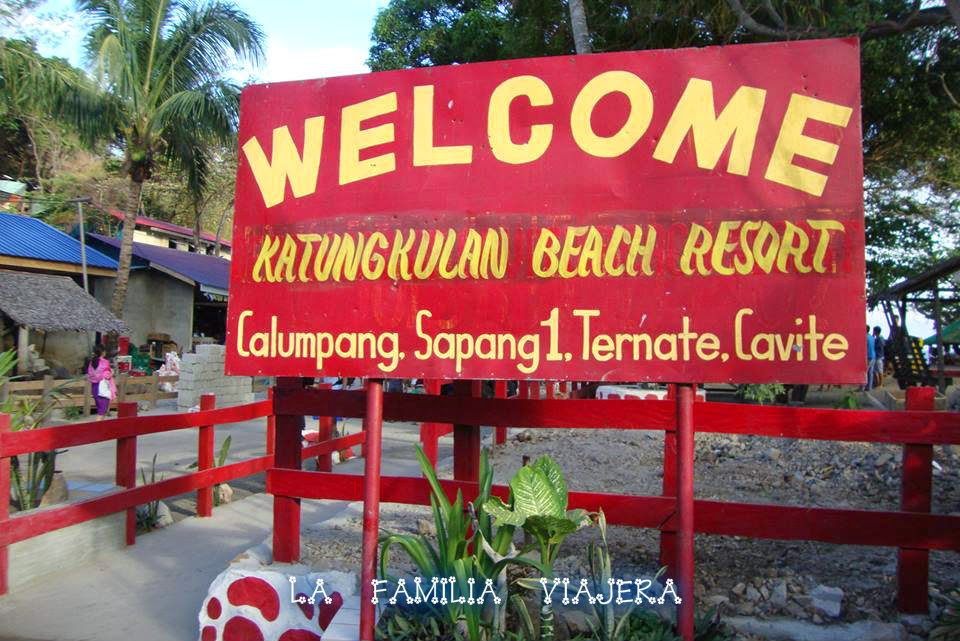
Yeyette grew up in Abra de Ilog, Mindoro Occidental. But Indang, Cavite is also a part of her personal history. Her dad, Jaime Perey, is from there. And she has spent many a happy childhood memory in that town, particularly during summer vacations. She has brought me there and Krystal many times in the past during the early years of our union.
Although not as stunning as Abra de Ilog, Indang still has its share of rural charm despite its proximity to Metro Manila and other urbanized areas. Rustic fields, clean rivers cutting through green-covered gorges, and small pockets of woodlands still abound the municipality and its surroundings. The climate is cooler too since the place is situated at almost a thousand feet (Indang is just a few kilometers away from foggy Tagaytay).
Indang was named after the tree bearing the same name (Artocarpus cumingiana Trec.). Founded in 1655, it used to be a barrio of Silang for about 70 years. But the distance between Indang and the población of Silang caused great difficulty for the residents of the former to transact business and attend religious services at the town proper. They then petitioned to be separated from the town matrix, a request that was granted in the aforementioned year. Juan Dimabíling was its first gobernadorcillo (today's equivalent of a town mayor).
Indang could very well be the most archival-conscious municipality not only in Cavite but in the entire country as well. One major reason for that is because it has kept a complete list of all its town heads, from Dimabíling in 1655 all the way to Bienvenido Dimero in the present.
 |
| Behind Jefe and Juanito is the former municipal hall of Indang. Somebody here told me that this structure will soon become a museum which will showcase the history and tangible heritage of the municipality. |
 |
| The ancestral homes here may not be as stunning compared to other towns, but they still add to the old-feel appeal of Indang. |
While Indang figured prominently during the Tagálog rebellion of the late 1890s, the events which transpired there didn't figure the same in the classroom teaching of Filipino History. For one, many do not even know that Andrés Bonifacio's arrest was caused by his actions here. There was looting and even an arson attempt at the town church (I've read an account or two that he ordered the burning of the church, but I could not remember which book or document). The havoc he was creating was due, perhaps, to his bitter rivalry with Emilio Aguinaldo in leading the rebellion against the government.
 |
| Iglesia de San Gregorio Magno. |
The most prominent native of Indang was Don Severino de las Alas (1851-1919), a lawyer who joined the Tagálog rebellion instigated by Bonifacio's Katipunan. In Filipino History, he is known as a member of the Magdalo faction of the Katipunan, hence an ally of Bonifacio's rival, Aguinaldo. He was appointed as Secretario del Interior during the Pedro Paterno cabinet in 1899. It was he who reported to Aguinaldo the untoward actions of Bonifacio and his men, particularly in Barrio Limbón. This was one of the reasons that prompted Aguinaldo to have Bonifacio et al. arrested.
After Aguinaldo's capture by the U.S. troops in 1901, de las Alas, together with General Mariano Trías (whose hometown of San Francisco de Malabón is now named after him) and Ladisláo Diuà (one of the co-founders of the Katipunan) surrendered after realizing that all has been lost in the war of resistance against the U.S. invaders. Years later, after his release from prison, he tried to run for governor of Cavite in 1910 but lost to General Tomás Mascardo.

Speaking of Don Severino, Yeyette may not be the only one to have blood ties in Indang. Of course it is noticeable that Don Severino's last name is closer to mine. In fact —and this is according to the seniors in my clan, many of whom have already passed away—, our original last name was de las Alas, and that my great grandfather shortened it to Alas for reasons still unclear. I even remember seeing an old calling card of an uncle of mine; he was using de las Alas instead of just Alas. But I do remember that, as a child, whenever I inquire from them why our last name was shortened, I never got a straight answer. "¡Basta Alas at de las Alas, parejo lang yun!" was the usual curt reply that I got, as if they don't want to talk about it. That's why when I first encountered the name Severino de las Alas back in our college history class, I became more intrigued than ever. Parejo lang dao, eh.
Are we related to him?
During our brief stay in Unisan over a decade ago, when Krystal was still a toddler, I asked my grandmother the name of her father-in-law as she and Auntie Nam (may they both rest in eternal peace) were preparing the ingredients for our lunch. It was a hot and lazy summer morning, so I thought of watching them do their culinary thingie (they were excellent cooks, if I may add). In response to my query, my abuela blurted out: "¡Severino!" My jaw dropped when I heard the name. So I asked her if he was the one who shortened our last name, and she said yes. I then told them of this Severino de las Alas in Filipino History, but they just shrugged. It seemed to me that they didn't even know who I was talking about. Bacá capañgalan lang dao. So I just stopped inquiring. At least I was left with a clue.
But they were correct. After all, Severino de las Alas (the historical figure, not my great grandfather) died in 1918, or seven years before my grandfather was even born (he was survived by his wife Agripina Jeciel and their children Teófilo and Guadalupe). Or could it be that Don Severino fathered a bastard and named the child after himself but changed/shortened the child's last name to appease the real family?
I started toying around with these questions when my great grandfather's name popped up again in a chit-chat during the final wake of my dear Auntie Nam a little over two years ago. My grandfather's only surviving sister, Lola Aida Alas de Jusoy, was also in attendance. And so I engaged her in a casual interview about the Alas - de las Alas connection, but she said she only knew a little about the real score. Nevertheless, she did share what she fondly remembers about her Tatay Binoy (their nickname for their father): the patriarch knew many local languages, most especially Spanish. I also learned from another relative that Tatay Binoy was one of the first people in Unisan to use dynamite for fishing (but this was a time when dynamite fishing was not yet generally considered an environmental hazard). Lola Aida's theory about the change in our last name was that somewhere down the line, there existed a family feud, probably a dispute in inheritance (a common problem among old-school Filipinos) or something like that. But really, she was not sure. However, her theory may hold water because I've heard of a similar story before. According to a former officemate of mine whose last name is Magallona, a faction of their clan slightly changed their last name by removing one letter "L" after an inheritance dispute. From that feud thus sprang the now famous Magalona surname (Enrique, Pancho, FrancisM).
Be it known that all this is just conjecture. But who knows?...
 |
| Krystal posing beside the monument and historical marker dedicated to Indang's most famous son, Severino de las Alas. |
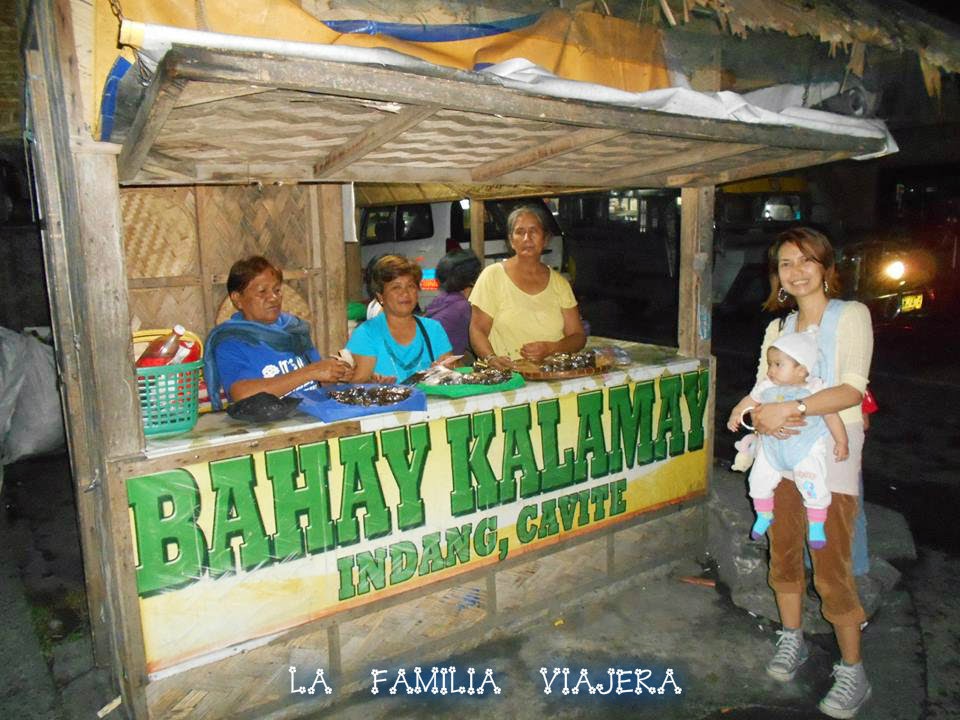 |
| You can find this eye-catching stall at the town plaza. The home-made "calamay" (a local delicacy made from coconut milk, brown sugar, and ground glutinous rice) is cheap but exquisite! |
❤L❤A❤F❤A❤M❤I❤L❤I❤A❤V❤I❤A❤J❤E❤R❤A❤
Last March 22 (a Sunday), the Rojales clan, of which my wife is a part of, had a reunion. The last time they had one was four years ago. In our family, only me and Yeyette attended it. This time, we brought the whole Alas caboodle. Krystal had been to Indang many times when she was still a baby, so this was like a homecoming for her although she could barely remember those visits. As for the rest (Mómay, Jefe, Juanito, and Clarita), it was just their first time.
The event was made more special because the most senior member of the clan, Lolo Cenón Rojales, was on vacation. Born on 12 April 1925, he is the only surviving sibling of my father-in-law's mother, Lola Natalia Rojales de Perey. Lolo Cen, Lola Talia, and three more siblings were the children of Don Dionisio Rojales and Doña Epifanía Feranil. Lola Talia was married to Lolo Benvenuto Perey, the son of Don Lope Perey and Doña Catalina Ersando. Lolo Cen is a retired engineer who has been staying in the U.S. since the late 1970s.
We were not supposed to attend the reunion because we're on a very tight budget. But Daddy Jimmy, as Yeyette's dad is known to family members, insisted that his uncle had wanted to meet Yeyette. This is because, according to many relatives, my wife bears a striking resemblance to her Lola Talia. Yeyette never met her Lola Talia who passed away before she was even born. Nor has she met her Lola Talia's brother, Lolo Cen. Besides, Lolo Cen was only on a short visit and will have to fly back to the U.S. soon. So we obliged (we also took it as an opportunity to explore a little of the población before and after the event).
 |
| The Rojales Clan reunion was held at this postwar "bahay na bató" owned by an auntie of Yeyette. |
 |
| Assorted Filipino cuisine such as paella, embutido, menudo, etc. filled our plates and satisfied our palates (photos courtesy of Yeyette's cousin Frances Jill Alcántara). |
 |
| Daddy Jimmy (right) introducing Yeyette and our daughters to his 89-year-old "balicbayan" uncle. |
 |
| Four generations of Rojales. Lolo Cen (right) is joined by his nephew, my father-in-law Jimmy Perey (wearing cap) and La Familia Viajera (photo courtesy of Frances Jill Alcántara). |
 |
| Lolo Cen (seventh from left) with his grandnephews and grandnieces. Yeyette is at second from left (photo courtesy of Frances Jill Alcántara standing at right). |
 |
| Three generations: Cenón Rojales y Feranil (middle) is the uncle of Jaime Perey y Rojales (left), the father of my wife Jennifer "Yeyette" Perey de Alas (right). |
 |
| Click here to see more photos of our Indang visit! |
The thing we like about family reunions is that we are able to reconnect to family members whom we have not seen for a very long time (such as Tita Lydia, Daddy Jimmy's sister) as well as meeting those whom we have not yet met (such as Lolo Cen). Time and distance may have separated family members, but the filial bond somehow remains. After all, blood is thicker than water.